

Devices covered by data recovery services Kenya Nairobi
Recovery methods depend on the storage medium, controller design, encryption status, and fault type. A logical deletion on a flash drive needs a very different approach from a physically damaged hard drive or a degraded server array.
Need reliable data recovery services in Kenya or Nairobi? Hi Tech Data Group recovers lost data from hard drives, SSDs, phones, servers, and other storage devices.
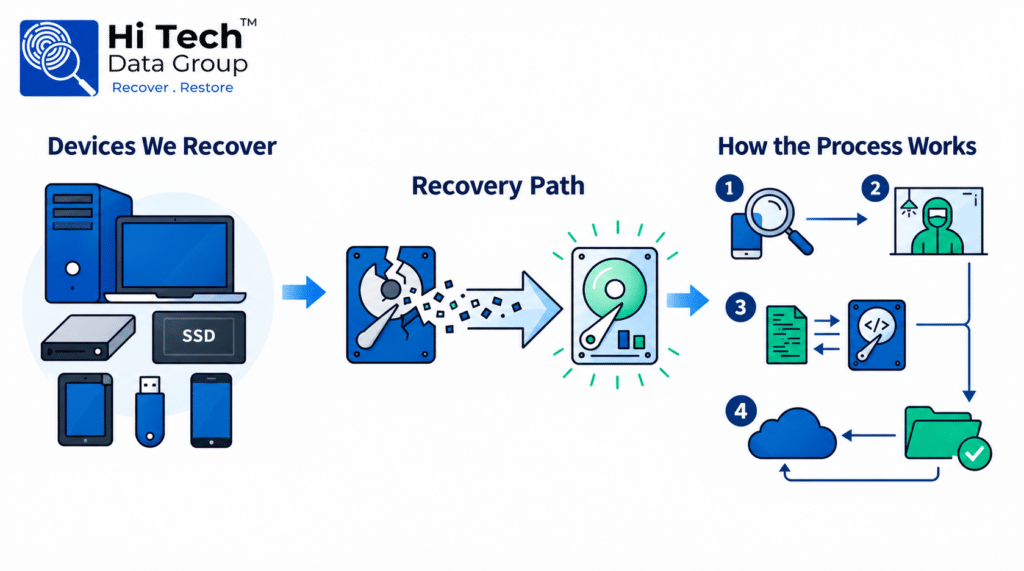
| Device or system | Typical symptoms | Recovery approach | Important first action |
|---|---|---|---|
| Internal or external hard drive | Clicking, slow access, missing partition, drive fails to mount | Imaging, file-system reconstruction, or controlled hardware repair | Power it off if mechanical noises occur |
| SSD | Drive vanishes, read-only errors, controller failure | Controlled access, firmware-aware analysis, and logical reconstruction where possible | Stop writing new data immediately |
| Laptop | Won’t boot, liquid damage, corrupted profile | Remove and assess the internal storage or work from a stable system image | Avoid repeated boot attempts |
| RAID or server | Degraded array, multiple failed disks, failed rebuild | Map disk order, RAID parameters, and virtual volumes before reconstruction | Pause rebuild activity and preserve every member disk |
| NAS | Shared folders unavailable, volume crash, enclosure fault | Assess drives and array configuration separately from the NAS unit | Do not initialise replacement disks |
| Mobile phone, memory card, or flash disk | Deleted photos, damaged file system, unreadable media | Logical recovery or specialist media assessment | Stop capturing photos or saving files to the device |
Hi Tech Data Group has dedicated service pages for hard drive data recovery in Kenya, SSD data recovery, and RAID recovery in Nairobi. Selecting the correct path early prevents a consumer-level fix from creating extra damage.
What affects data recovery cost and turnaround time in Kenya
The quote and timeline depend on the device and fault, rather than a single standard rate. A logically deleted folder from a healthy drive generally requires a different effort level from a multi-disk RAID with unreadable sectors or a physically damaged hard drive.
Key factors include storage capacity, the failure type, the amount of data required, encryption, device condition, parts requirements, RAID complexity, and urgency. Emergency handling may require a different scheduling path. Define the files that matter most during intake, especially where a large server contains years of data but only current records are urgent.
Ask for a written scope before approval. It should identify the source device, the desired data, the recovery route, the expected delivery method, and any conditions that could affect timing.